Papers · Plate 01
Punch Called It a Cartoon in 1843, and the Word Never Went Back
How a cheap London comic weekly coined the modern meaning of its medium, ran for a century and a half, and left its archive at the British Library.
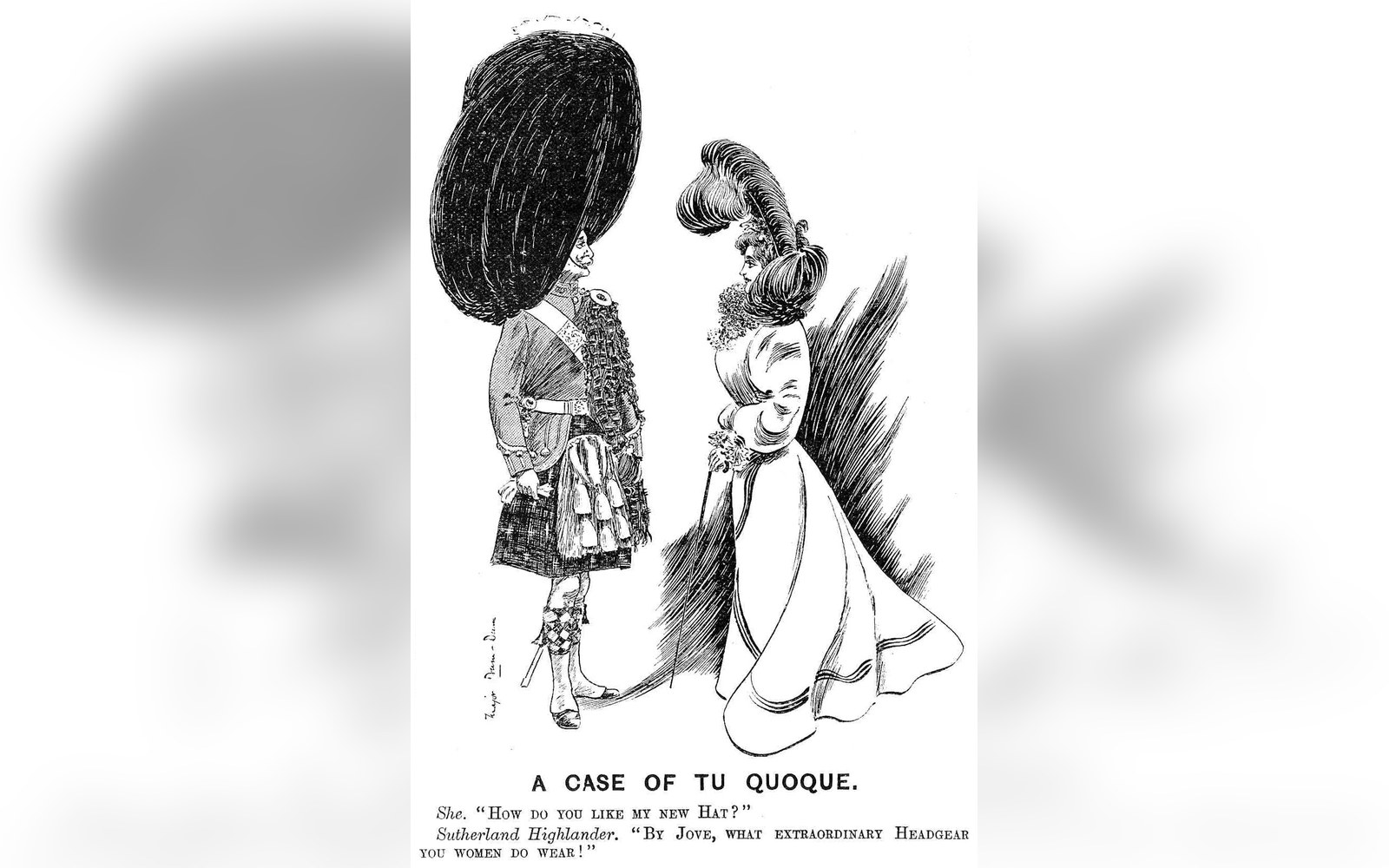
A late Punch page: the joke has become an institution and the block has become a zinc plate.
Photo: Punch-Tu Quoque 1904 · Wikimedia Commons
From a Shilling Funny to an Institution
Punch, or the London Charivari launched on 17 July 1841, founded by the engraver Ebenezer Landells, the journalist Henry Mayhew, and the printer Joseph Last, with Mark Lemon installed as the first editor. The subtitle acknowledged a direct debt to Le Charivari, the Parisian satirical paper that had been running since 1832, though Punch quickly shed the comparison and developed its own register: clubbable, reformist in its early years, and visually ambitious in a way no British weekly had quite managed before. The price was threepence an issue, making it genuinely accessible to the urban reading public rather than merely to the carriage trade.
The early Punch was scrappier and more radical than its later reputation implies. It campaigned against the Corn Laws, printed sharp pieces on poverty and housing, and gave space to the young John Leech, whose social caricatures of the 1840s rank among the best draughtsmanship in Victorian periodical publishing. The masthead itself — a Punch-and-Judy puppet looming over a street scene — announced a tradition of licensed insolence that the magazine never entirely abandoned even as it grew respectable.
The large cut ran where a reader opening the issue met it first.
Photo: Christian Wasserfallen / Pexels
Wood engraving was the production method throughout the mid-Victorian decades. Drawings were transferred to the end-grain boxwood block and cut by a team of engravers working simultaneously on different sections, a practice that allowed the weekly deadline to be met but that occasionally shows in the finished print as subtle tonal inconsistencies across the image. From the 1880s onward the zinc line block began replacing the boxwood, and by the Edwardian period the hand-cut block had effectively disappeared from Punch's pages, though the aesthetic continuity was carefully maintained.
The Table, the Cartoon, and the Word
The Punch Table was a documented working institution, not a legend. The editors and senior contributors gathered weekly around a large table at the magazine's offices — first in Fleet Street, later at Bouverie Street — to decide the subject of the main political cartoon, called the "Big Cut." The table itself, acquired early in the magazine's history, was literally carved with the initials of contributors, and the ritual of the Wednesday dinner preceding the weekly editorial decision became one of the most discussed practices in Victorian journalism. John Tenniel, who served as principal cartoonist from 1850 to 1901, attended these dinners for five decades and produced his weekly cartoon based on the consensus reached there.
Chronology
- 17 July 1841Punch founded by Landells, Mayhew, and Last; Mark Lemon first editor
- 1843Punch coins "cartoon" in its modern sense, parodying the Westminster fresco competition
- 1850John Tenniel begins as principal cartoonist
- March 1890Tenniel's Dropping the Pilot published, on Bismarck's dismissal
- 1901Tenniel retires after fifty-one years
- 8 April 1992Punch closes after c. 7,700 issues
- 1996Mohamed Al Fayed revives the title
- 2002Second and final closure
The word that described what Tenniel drew had not yet settled into its modern meaning in 1841. In June 1843, the Houses of Parliament held a competition for preparatory drawings — in Italian, cartoni, full-scale designs on paper — intended to decorate the new Palace of Westminster, rebuilt after the 1834 fire. Punch, never able to resist a target, ran its own mock competition in the issue of 15 July 1843: a series of drawings satirising social conditions, captioned as "Punch's Cartoon No. 1" and so on, the joke being a direct parody of the solemn parliamentary exercise. The Italian cartone, meaning a large preparatory sheet, was being deflated into comic illustration. The word's drift from preparatory drawing to satirical image was not instantaneous, but this documented moment in Punch's pages is the clearest hinge: within a generation, "cartoon" in English meant the thing Punch printed each week, not the thing Parliament commissioned.
The political cartoon's subjects across those 150 years constitute a nearly continuous visual history of British and international affairs. Tenniel's Dropping the Pilot, published in March 1890 following Bismarck's dismissal by the Kaiser, is among the most cited images in the archive. Bernard Partridge, Leonard Raven-Hill, and E. H. Shepard followed Tenniel in the principal seat, and the magazine's second-world-war period, under Bernard Partridge, produced work that still circulates in histories of the conflict. The postwar decades brought a gradual loss of cultural centrality, as television and then the tabloid press displaced the weekly magazine as the public's primary site of visual satire, but Punch continued to publish and to attract significant draughtsmen until its closure.
Framed on a wall a wood engraving is an object. On the page it was one week’s argument.
Photo: Beyzaa Yurtkuran / Pexels
Closure, Revival, and What Remains
Punch ceased weekly publication on 8 April 1992, after 150 years and approximately 7,700 issues. Declining circulation and the collapse of the advertisement market for the upmarket weekly had made the title financially unsustainable under its then owner, United Newspapers. A revival followed in 1996, when the Egyptian businessman Mohamed Al Fayed acquired the title; the revived Punch ran until 2002, when it was closed again, this time without the extended mourning that had attended the 1992 shutdown. The revival produced some distinguished cartoonists but never recovered the cultural authority of the original run.
The bound volume series — Punch was issued in half-yearly bound volumes from very early in its history — is held comprehensively at the British Library ↗, where researchers can consult the complete run. The British Library holds not only the printed volumes but a substantial body of associated material. Original artwork is distributed across several collections: the British Cartoon Archive at the University of Kent holds a large quantity of twentieth-century Punch drawings, including significant holdings of Illingworth, Searle, and later contributors, and publishes finding aids through its online database. The Victoria and Albert Museum holds earlier material, including some Tenniel drawings, and the British Museum's department of prints and drawings contains Georgian-period work that preceded Punch's founding but contextualises its visual inheritance.
Ronald Searle, whose work appeared in Punch from the late 1940s, is well represented in the Kent archive; Gerald Scarfe contributed to the later decades; and the magazine's covers, which became increasingly photographic and typographically experimental in its final years, mark the distance the title had travelled from Leech's woodblock caricatures.
What the 1843 cartoon joke did, and what no one planned, was fix a word. English has no synonym for it: "caricature" is something narrower, a portrait-based exaggeration; "illustration" is something more neutral. "Cartoon" carries the compression, the argument, and the slight absurdity that the Punch joke loaded into it. The word arrived at its modern meaning by accident, in a parody of parliamentary pomposity, in a magazine that cost pennies and lasted a hundred and fifty years.