Glossary · Plate 01
Cartoon: How a Preparatory Drawing Became an Insult
A single issue of Punch in 1843 hijacked a technical term from the fine arts and gave it to political satire permanently.
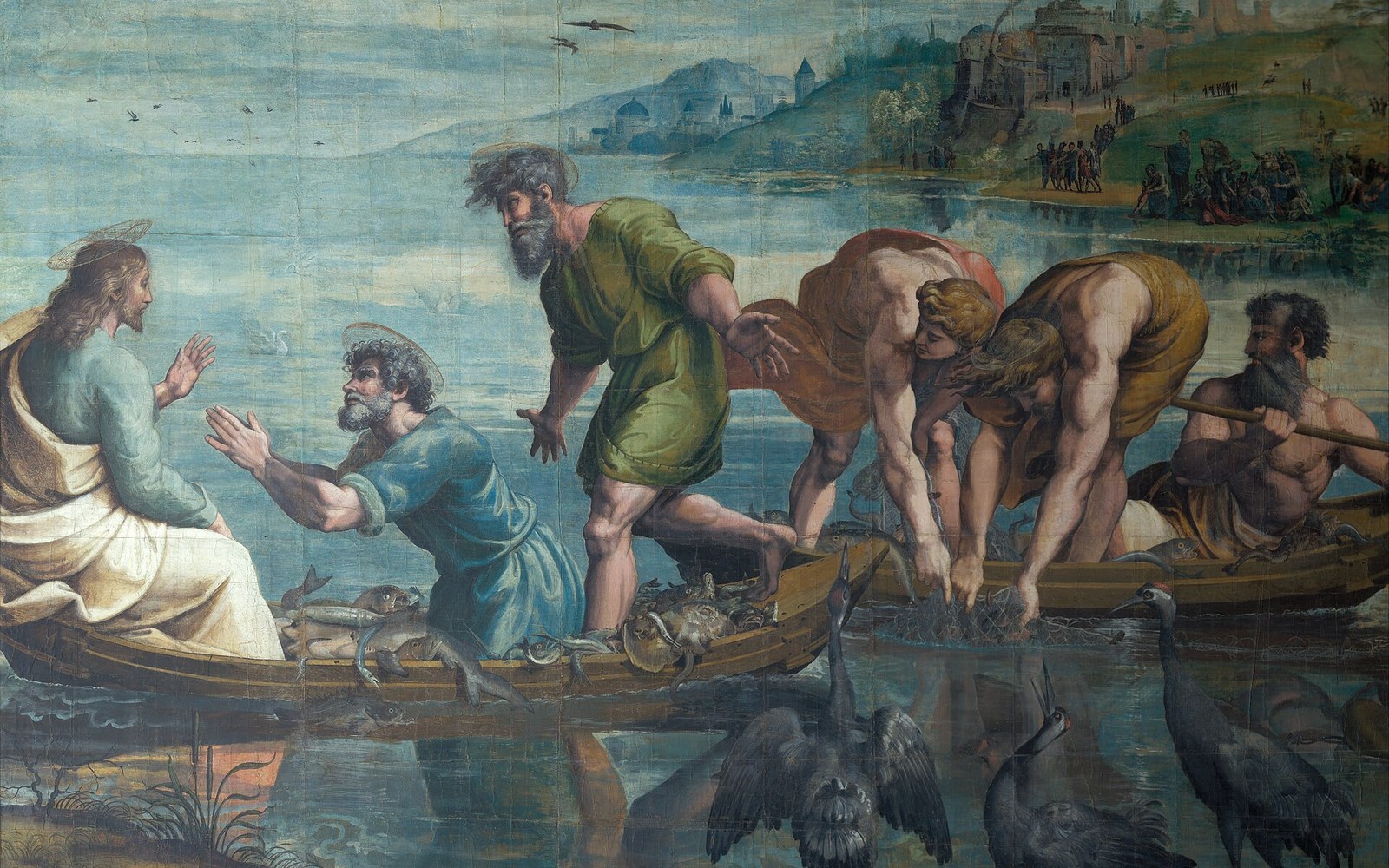
A cartoon in the older sense: Raphael’s full-scale design on paper, made to be transferred.
Photo: Raphael - The Miraculous Draft of Fishes - Google Art Project · Wikimedia Commons
From the Florentine Workshop to the Palace of Westminster
In the vocabulary of Renaissance painters and tapestry makers, a cartone — Italian for a large sheet of paper — was a full-scale preparatory drawing, the master design from which a fresco or woven panel would be produced. The word crossed into English as cartoon in the same neutral, technical sense: a working drawing, nothing more. When Raphael made his designs for the Sistine tapestries in 1515–16, those sheets were cartoons in precisely this meaning. Seven of them survive and are held at the Victoria and Albert Museum, London, where they have been on long-term loan from the Royal Collection since 1865.
The word retained that value — draughtsman's shorthand for a preparatory study — through the seventeenth and eighteenth centuries without acquiring comic or political freight. Hogarth's prints were called prints, caricatures, satires; nobody called them cartoons. Gillray's etchings were etchings. The term sat quietly in the studio while political imagery developed its own vocabulary elsewhere.

Framed on a wall a wood engraving is an object. On the page it was one week’s argument.
Photo: Beyzaa Yurtkuran / Pexels
Then, in the summer of 1843, the term was ambushed. The Palace of Westminster, still under reconstruction after the 1834 fire, staged a public exhibition of full-scale preparatory drawings — cartoons, in the old sense — submitted for competition to decorate the new building with frescoes. Punch, then only two years into its run, published a mock commentary under the heading "Cartoon No. 1" in its issue of 15 July 1843. The piece was a drawing, John Leech's "Substance and Shadow", captioned "Cartoon, No. 1"; later issues ran further drawn parodies. The joke was pointed: while Parliament debated funding for grand decorative art, the poor were starving. The Punch team's use of "cartoon" ↗ was a deliberate, sardonic appropriation of the official exhibition's own terminology, turning a prestige word into a vehicle for mockery.
The Oxford English Dictionary records this 1843 Punch usage as the first citation in which cartoon carries the meaning of a humorous or satirical drawing intended for publication. Within a generation the older, technical meaning was the secondary one. By the time Punch had its Tenniel and its wood-engraved blocks and Harper's Weekly had Thomas Nast, cartoon simply meant what the public saw on the page: a drawn argument, not a workshop diagram.
The shift is tidy enough to seem planned, but it was a journalist's opportunism, not a lexicographer's decision. A competition word became a press word, and the press never gave it back.