Draughtsmen · Plate 05
Tenniel's Fifty Years on the Punch Block
The man who drew Alice also drew the British Empire's conscience — for five decades, on end-grain boxwood, without missing a week.
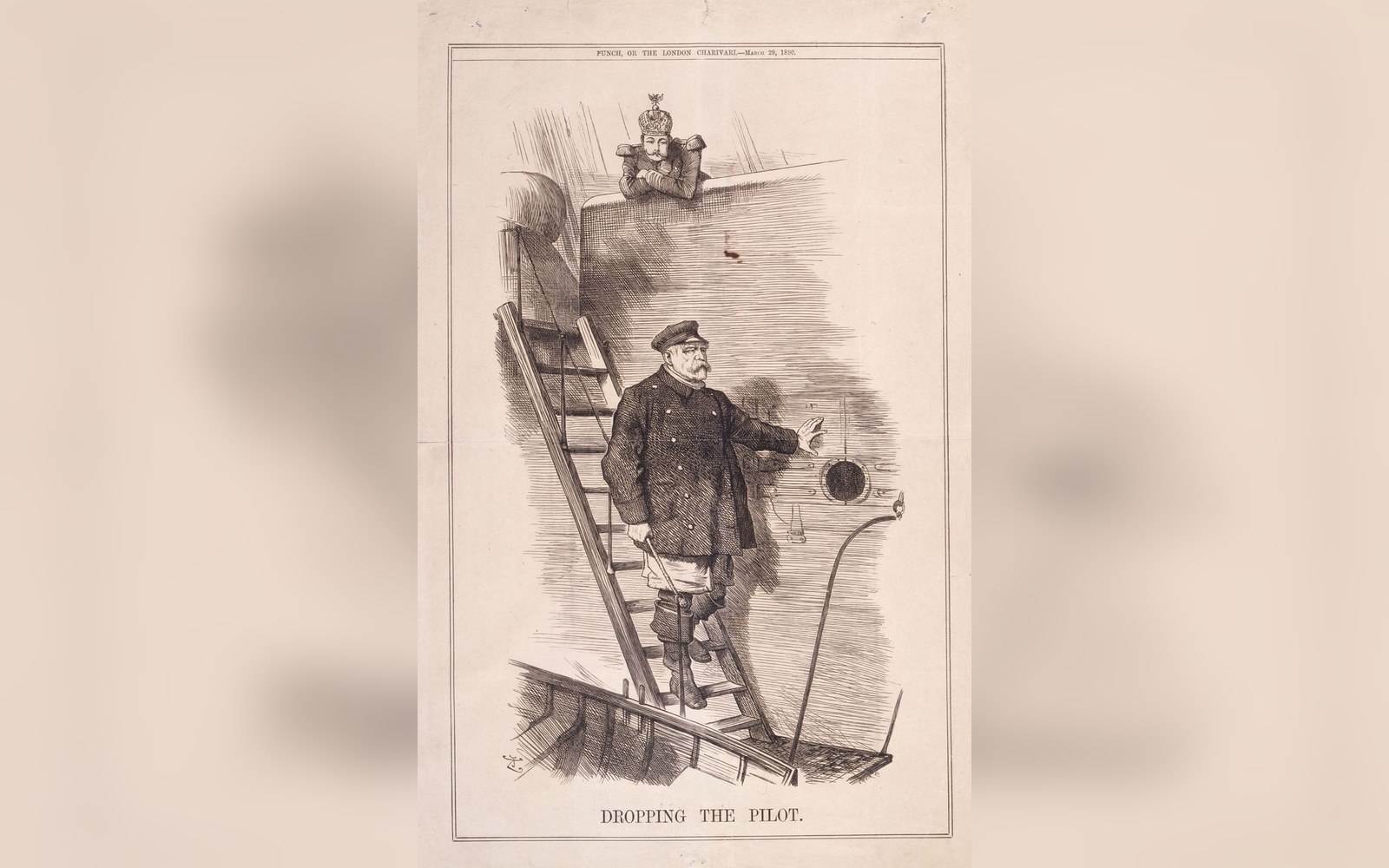
Bismarck goes down the ladder and the Kaiser leans on the rail: fifty-one years of Wednesday dinners produced this one.
Photo: Dropping the Pilot · Wikimedia Commons
The Block and the Draughtsman
John Tenniel joined Punch in 1850 as second cartoonist to John Leech, became principal cartoonist on Leech's death in 1864, and held the position until his retirement in 1901 — a span of more than fifty years that brackets the high Victorian age almost perfectly. No other draughtsman so thoroughly shaped what a British political cartoon was expected to look like: authoritative, architecturally composed, legible at a glance, and suffused with a classical reference bank drawn from his early training at the Royal Academy Schools.
His medium was wood engraving, the standard technique of mid-Victorian illustrated journalism. Tenniel drew in reverse directly onto the polished end-grain boxwood block, and the engraving was cut by the Swain workshop, which handled Punch's production throughout his tenure. What reached the reader was therefore a collaborative object: Tenniel's line as interpreted by professional cutters who worked, on a tight weekly deadline, from his pencil to their gravers. He was unusual among major cartoonists of the period in that he drew without preparatory photographic transfer to the block, trusting his reversed draftsmanship — a discipline that compressed time and sharpened his instinct for bold, unambiguous outline. Because the block itself was destroyed in printing, the British Cartoon Archive, which holds a substantial run of Punch material, works primarily from bound volumes and proofs rather than Tenniel originals.
The large cut ran where a reader opening the issue met it first.
Photo: Christian Wasserfallen / Pexels
The Cuts That Lasted
The most-reproduced image from Tenniel's career is almost certainly Dropping the Pilot, published on 29 March 1890, following Otto von Bismarck's dismissal by Kaiser Wilhelm II. It shows the old chancellor descending a ship's ladder as the young emperor watches from the deck above — a composition so economical that it required no caption beyond the title to communicate its meaning to readers across Europe. The image circulated far beyond Punch's own press run through wood-engraved reproduction ↗ in Continental and American papers, and it remains one of the most cited cartoons of the nineteenth century.
Earlier, The British Lion's Vengeance on the Bengal Tiger (1857) — a ferocious response to the Indian Rebellion — demonstrated Tenniel's readiness to deploy allegorical animals in ways that carried considerable racial animus by any later standard. Britannia Sympathises with Columbia (1865), mourning Abraham Lincoln's assassination, showed the same animal grammar put to more generous use. Both cuts document the range of political positions Punch occupied under different editorships, and both appear in the digitised bound volumes held by the British Library, which constitute the most complete accessible run of the magazine.
Key dates
- 1850Tenniel joins Punch as second cartoonist
- 1864Becomes principal cartoonist on Leech's death
- 1890,29 March Dropping the Pilot published
- 1893Knighted: the first cartoonist in British history to receive the honour
- 1901, JanuaryRetires; succeeded by Leonard Raven-Hill
- 1914Tenniel dies
His technique evolved only slowly. He adopted a slightly broader, more heraldic line in later years, partly in response to changing reproductive processes but partly, it is recorded in Punch's editorial correspondence, because declining eyesight — he lost the sight of his right eye in a fencing accident in 1840 — made the finest cross-hatching increasingly impractical. The loss, sustained a decade before he joined the magazine, had never prevented precision; it had shaped a compositional habit of thinking in planes and silhouettes rather than in accumulated fine tone.
Editorial Partnership
Tenniel worked under several editors, but his relationship with Francis Burnand, who edited Punch from 1880 to 1906, was notably businesslike rather than warm. The weekly cartoon subject was set by the editorial table — the Wednesday "Punch dinner" at which the principal contributors debated the political moment — and Tenniel was expected to translate the collective verdict into a finished drawing within days. He rarely dissented publicly, but the record suggests he occasionally redirected a subject's emphasis through his visual choices in ways the table had not precisely specified. His knighthood in 1893, the first awarded to a cartoonist in British history, acknowledged a body of work that had become part of the national visual furniture, even if Punch itself took credit by association.
He retired in January 1901, shortly before Queen Victoria's death, and was succeeded by Leonard Raven-Hill ↗. He died in 1914. The Swain blocks are gone; the printed page survives.