Papers · Plate 02
Harper's Weekly Ran the War and the Cartoons Together
The illustrated paper that made American political cartooning a national institution, built on wood engraving and Civil War reporting.
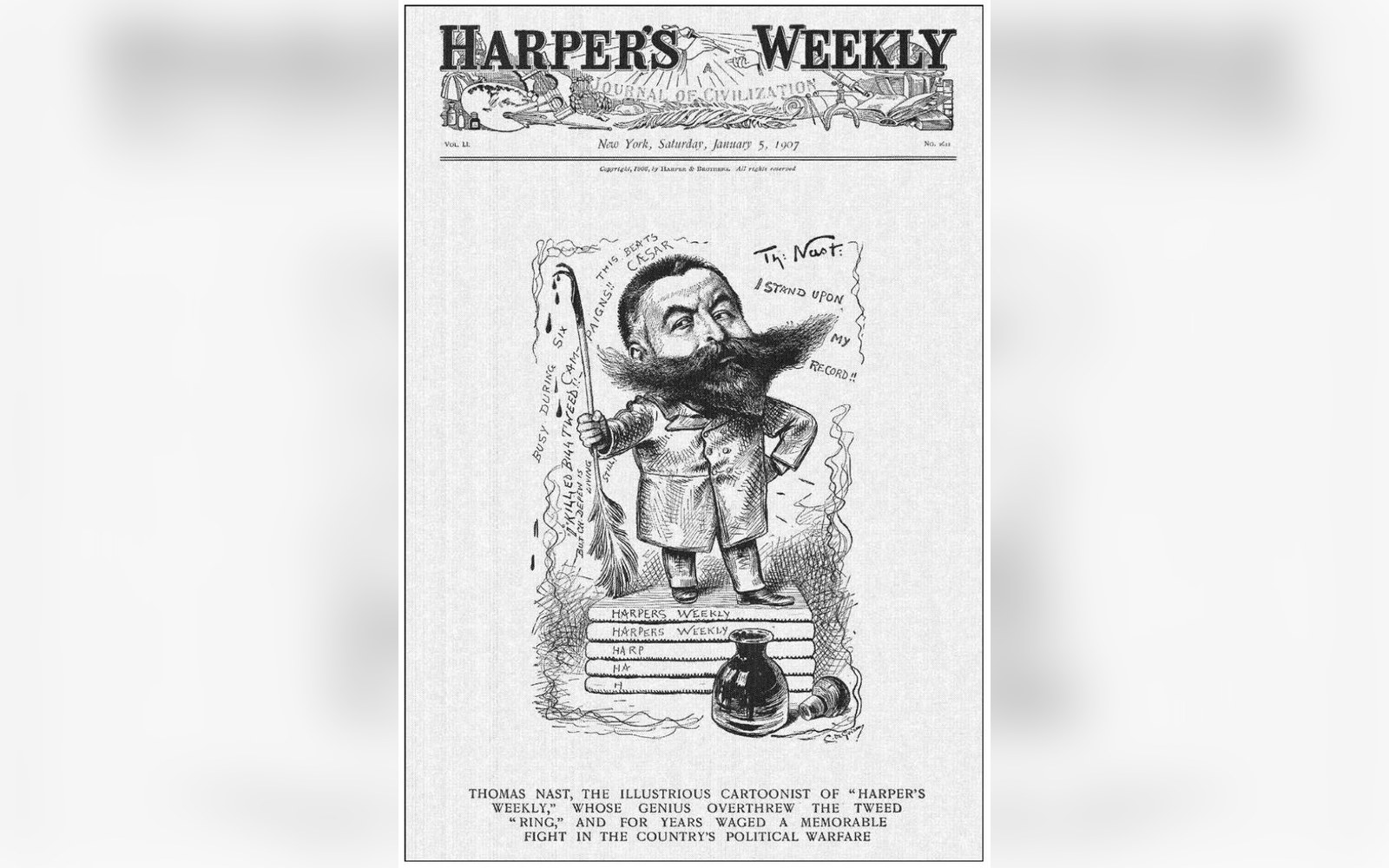
The paper put its own cartoonist on the cover, standing on his bound volumes.
Photo: Harper's Weekly cover January 5, 1907, Nast by C. de Grimm · Wikimedia Commons
From its 1857 launch through the Civil War and Gilded Age, Harper's Weekly shaped what American readers expected a political cartoon to look like — and what it could accomplish.
A Journal of Civilization Built on Boxwood
Harper & Brothers launched Harper's Weekly in January 1857, billing it "a journal of civilization" and modeling it loosely on the Illustrated London News. The timing was precise: a national audience hungry for pictures had almost no domestic source to turn to. The magazine's editorial offices sat in New York, but its reach, carried by rail and post, was effectively continental from the start.

Bound half-yearly volumes are why the weeklies survive at all: loose issues were read to pieces.
Photo: Yaroslav Shuraev / Pexels
The engine of that reach was wood engraving: skilled craftsmen working on end-grain boxwood blocks reproduced drawings in fine, pressable relief. A single large illustration might be sawn into a dozen interlocking sections, each assigned to a different engraver, then bolted back together for printing — a production method that let the magazine respond to events within days. During the Civil War, staff artists followed Union armies into the field; their sketches returned to New York by courier, were transferred to the block, and appeared in the next issue. The Library of Congress ↗ holds bound runs of the weekly that preserve the full print quality of these wartime issues — the tonal range possible with fine engraving visible even after a century and a half.
Nast and the Years That Counted
Thomas Nast joined Harper's Weekly in 1862 and remained its most consequential voice for more than two decades. His Civil War images — allegorical, emotionally direct, rendered with the controlled line that wood engraving demanded — established him as a public figure rather than a jobbing illustrator. Abraham Lincoln reportedly called him "our best recruiting sergeant," though the precise source of that attribution remains debated.
Chronology
- 1857Harper's Weekly founded by Harper & Brothers, New York
- 1862Thomas Nast begins regular contributions
- 1869–71Nast's Tweed Ring campaign; peak political influence
- 1872Magazine supports Grant against Liberal Republican challenge
- 1886Nast resigns
- 1880sZinc line block begins displacing wood engraving across the industry
- 1916Harper's Weekly merges with The Independent; ceases independent publication
The campaign against William Magear Tweed and Tammany Hall, running from 1869 to 1871, demonstrated what the magazine and the cartoonist could do together as an instrument of political pressure. Thomas Nast's sustained campaign against the Tweed Ring produced images that circulated far beyond Harper's Weekly's own press run: reprinted on broadsides, discussed in rival papers, they made Nast's visual vocabulary — the tiger, the vulture, the moneybag — into common political currency. Tweed himself understood the mechanism; he reportedly feared the cartoons more than the newspaper editorials because readers who could not follow the prose could still read a picture.
Publisher Fletcher Harper backed Nast through the Tweed years and through the contested 1872 presidential campaign, when Harper's Weekly opposed the Liberal Republican challenge to Ulysses Grant. By the mid-1880s, however, the relationship had frayed. Editorial policy shifted; Nast's influence at the paper diminished. He resigned in 1886, and Harper's Weekly never again had a cartoonist of comparable reach on its staff.
The Long Decline
After Nast's departure, Harper's Weekly remained a significant periodical but ceased to define the form. The photomechanical zinc line block, coming into general use through the 1880s, broke the wood engravers' monopoly on illustrated journalism; meanwhile, Joseph Keppler's Puck and its rival Judge had claimed the satirical market with chromolithographic colour that Harper's Weekly's sober format never attempted. The magazine continued until 1916, when it merged with The Independent, but its political cartooning in the final decades rarely rose to the urgency of the Nast era. What it left behind — the bound volumes, the original blocks where any survive, the demonstrated fact that an American illustrated paper could move public opinion — remained the baseline against which every later practitioner of the form measured the work.