Papers · Plate 03
Puck Was the Only Thing Funnier Than Congress
The American magazine that weaponised colour lithography against the Gilded Age, and how Joseph Keppler's Puck out-mocked its rivals.
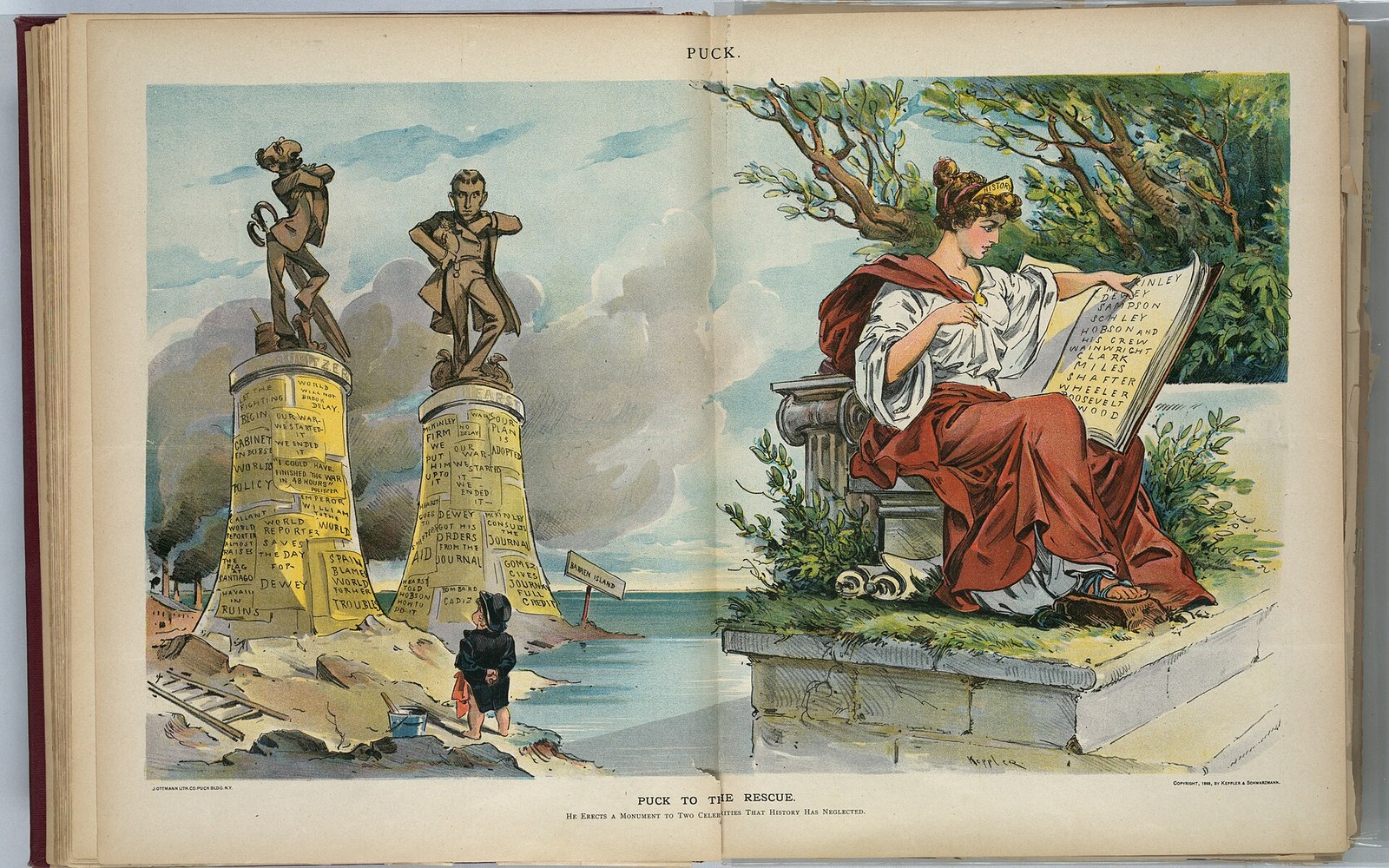
Chromolithography gave Puck a centrefold in full colour while its rivals were still in black.
Photo: Puck to the rescue - Keppler. LCCN2012647477 · Wikimedia Commons
From German-Language Curiosity to National Satirical Force
Joseph Keppler launched the first version of Puck in St. Louis in 1871, publishing in German for the city's substantial immigrant readership. The venture folded within the year, but Keppler was not finished. He moved to New York, spent several years as an illustrator at Frank Leslie's Illustrated Newspaper, absorbed the mechanics of the American periodical market, and in 1876 founded a second Puck — again in German, again in New York. The English-language edition followed in March 1877, and it was this version that changed American political cartooning permanently.
The timing was exact. The Gilded Age was generating political corruption faster than daily newspapers could document it, and Puck arrived with a format — large folio pages, three full colour plates per issue, and a tone of theatrical mockery — that daily journalism could not match. Within five years the English edition had buried its German sibling in circulation and become the most widely read satirical weekly in the United States.

Grease crayon on limestone takes the pressure of the hand. It is why a lithograph looks drawn and an etching looks cut.
Photo: Akshar Dave🌻 / Pexels
Chromolithography as Editorial Argument
What separated Puck from every competitor was the chromolithographic colour process it used from the outset. Chromolithography ↗ — printing successively from multiple lithographic stones, one per colour — was expensive and technically demanding, but it allowed a richness of tone and a vividness of political caricature that black-and-white wood engraving simply could not deliver. Keppler understood that colour was not decoration; it was emphasis. A bloated politician rendered in hot reds and sickly yellows landed differently than the same figure in newsprint grey.
Keppler was the magazine's principal cartoonist as well as its co-founder, and his draughtsmanship was the editorial heart of the operation. Trained in Vienna before emigrating, he brought a European fluency in allegorical figure composition to the American scene — large crowds of identifiable faces, symbolic backdrops, and captions that could be read at a distance. His full-page centrefolds and front-cover plates became the format other magazines attempted to imitate. Judge, founded by former Puck staff in 1881, replicated the folio size and the colour process almost exactly, and the two magazines ran competing satirical commentary through the 1880s and into the 1890s. Puck was nominally Democratic in its sympathies; Judge leaned Republican. Both depended on Keppler's original template.
Chronology
- 1871Keppler founds the first Puck in St. Louis (German-language; short-lived)
- 1876Second Puck launched in New York, again in German
- March 1877English-language edition begins publication
- 1881Judge founded by former Puck contributors
- 1885–1893Puck Building constructed on Houston Street, Manhattan
- 1894Joseph Keppler dies; his son continues the editorship
- 1918Puck ceases publication
The Puck Building and the Magazine's Legacy
By the mid-1880s Puck was successful enough to require purpose-built premises. The Puck Building ↗, constructed on Houston Street in lower Manhattan between 1885 and 1893 to designs by Albert Wagner, carried two gilded figures of Shakespeare's Puck on its exterior — one at street level, one high on the corner cornice — announcing the magazine's occupant to the neighbourhood. The building outlasted the magazine by more than a century and survives today as a landmark, the figures still in place.
Puck published continuously until 1918, long after Keppler's death in 1894. His son, Joseph Keppler Jr., carried the editorship forward, but the magazine's most ferocious satirical energy belonged to the founder's decades. The Billy Ireland Cartoon Library and Museum at Ohio State University holds a substantial collection of Puck material, including original chromolithographic plates and printed issues, representing one of the most complete archives of the magazine's production history in American institutions.
What Puck demonstrated, issue by issue through the Gilded Age, was that political satire required not just a sharp argument but a medium equal to its ambitions. Colour, scale, and the willingness to name names directly — these were Keppler's weapons. Congress provided the material; Puck provided the process.