Prizes · Plate 01
The Pulitzer Prize for Editorial Cartooning, 1922 to the Present
America's most visible cartooning honour has rewarded pen-and-ink giants and sparked recurring arguments about what the form actually is
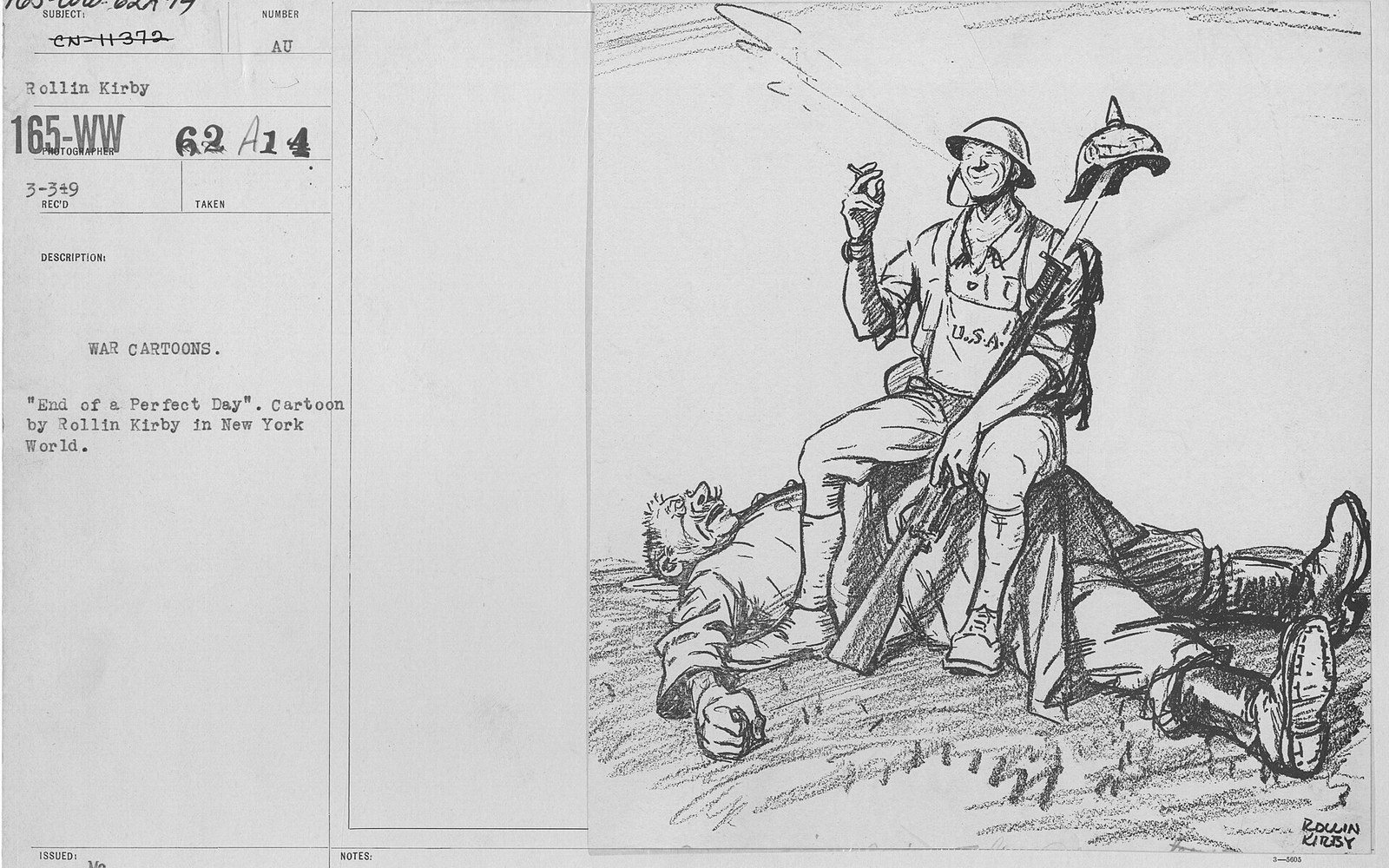
Rollin Kirby of the New York World, who took the first prize in 1922.
Photo: Rollin Kirby, "End of a Perfect Day," New York World / NARA via Wikimedia Commons
The Pulitzer Prize for Editorial Cartooning has been awarded annually since 1922, making it one of the oldest specialist categories in the prize family endowed by Joseph Pulitzer's 1904 bequest and administered since 1917 by Columbia University. The award's stated criterion — distinguished cartooning in a United States newspaper or wire service, characterised by the use of a dominant motif accompanied by such subsidiary pictorial and text material as may be appropriate — has remained broadly stable for a century, yet its application has generated more sustained controversy than almost any comparable category.
The early decades and the canon
The first recipient, in 1922, was Rollin Kirby of the New York World, who went on to win three times before 1929 — a feat later matched by Herblock and others. The interwar years rewarded cartoonists working in the dominant pen-line tradition: single-panel drawings, often allegorical, printed in daily broadsheets. That house style was already well established when Bill Mauldin won in 1945 for his Stars and Stripes work featuring Willie and Joe — a striking choice, since Stars and Stripes was a military paper rather than a civilian daily, and Mauldin was twenty-three, the youngest winner to that point. He won again in 1959 at the St. Louis Post-Dispatch.
A forme locked up for a proof. The press set the deadline the drawing had to meet.
Photo: Antoni Shkraba / Pexels
Herbert Block, known as Herblock, accumulated three Pulitzers — in 1942, 1954, and 1979 — across his long tenure at the Washington Post. His 1954 win came in the same year his work helped define the visual language of McCarthyism, and the Herblock Foundation now administers a separate prize in his name. Pat Oliphant, who arrived from the Adelaide Advertiser to join the Denver Post in 1964, won in 1967 and went on to influence a generation of American editorial cartoonists through his technique and his wide syndication via Universal Press Syndicate.
The criteria controversies
The category's most persistent dispute concerns the boundaries of the form. From the mid-1970s onward, the Pulitzer Board faced submissions — and occasionally awarded prizes — to work that moved away from the single-image broadsheet cartoon toward multi-panel strips, illustrated essays, and what jurors and critics variously called "comic journalism" or graphic narrative. The tension peaked with the 1975 prize to Garry Trudeau for Doonesbury, a comic strip rather than a single editorial panel. The decision provoked open objection from the Association of American Editorial Cartoonists, whose members argued that a strip narrative belonged in a separate category. The Board eventually separated Doonesbury into the Distinguished Comics category, and Trudeau's Pulitzer stands alone.
Prize record highlights
- 1922First awarded; Rollin Kirby, New York World (first of three wins)
- 1945Bill Mauldin, Stars and Stripes, age 23; youngest winner at the time
- 1954Herblock (Herbert Block), Washington Post; McCarthy-era context
- 1967Pat Oliphant, Denver Post; third year after his arrival from Australia
- 1975Garry Trudeau, Doonesbury; triggered the strip-vs-panel debate
- 2001Ann Telnaes, Women's eNews; first woman to win; first web-based winner
- Suspended (no award): 1923, 1936, 1960, 1965, 1973, 2021
Digital production introduced a further definitional strain. Ann Telnaes won in 2001 for work at Women's eNews, becoming the first woman to win the category and the first winner whose primary medium was the web rather than print. The Pulitzer Board's published record ↗ shows that subsequent rules language explicitly extended eligibility to work published on news sites, formally acknowledging that the broadsheet page was no longer the sole venue.
The category has occasionally gone unawarded, each time because the jury concluded that no submission reached the required standard — a stringent position that the Board has maintained even under pressure to award. The 2021 suspension, the first in 48 years and coming as newsroom staff reductions were shrinking editorial cartooning departments across the country, drew particular attention from the Association of American Editorial Cartoonists as evidence of the form's institutional fragility.
Throughout its history, the prize has functioned as a barometer of what editors and administrators consider editorial cartooning to be, as much as a record of who drew best. The holdings at the Billy Ireland Cartoon Library and Museum ↗ at Ohio State University include original artwork by multiple winners, offering researchers a material counterpart to the Board's administrative record. The prize's century of decisions, suspensions, and arguments forms, in aggregate, a documentary history of American editorial cartooning's self-image — and of the tension between the form's popular vitality and its institutional definition.