Draughtsmen · Plate 07
Willie and Joe Never Saluted Anyone
Bill Mauldin's two-war career, his scruffy infantrymen, and the general who tried to shut them down
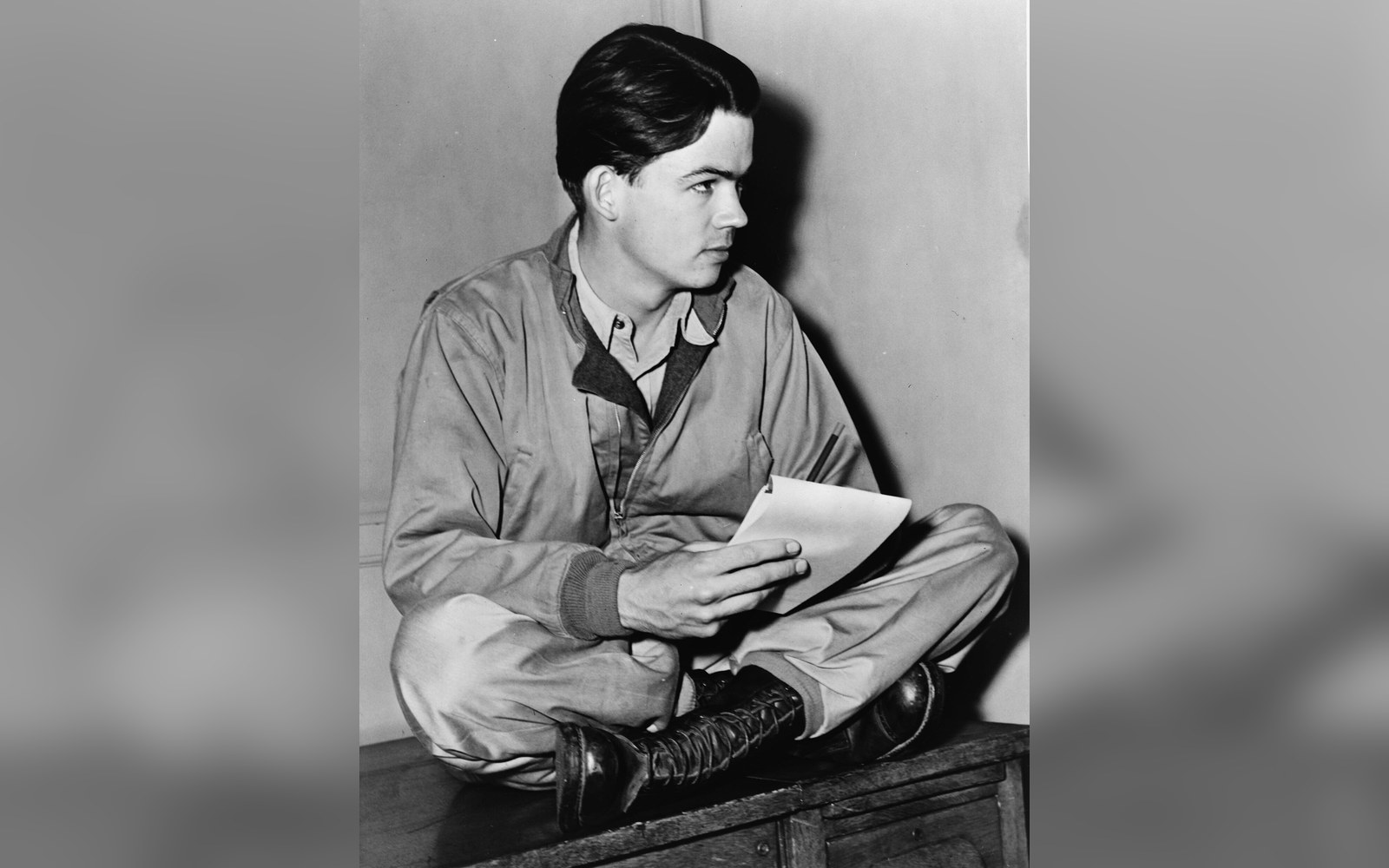
The cartoonist at twenty-three, drawing for the men he was serving beside.
Photo: Bill Mauldin NYWTS · Wikimedia Commons
Bill Mauldin was twenty-two years old when he began drawing Willie and Joe for Stars and Stripes, the U.S. Army's daily newspaper, and the two mud-caked, stubble-chinned infantrymen he created became the most recognisable enlisted men in American journalism. Neither character saluted willingly, neither stood at attention, and both regarded the officer class with the weary scepticism of men who had actually slept in Italian ditches. That disposition was the point.
Mauldin had joined the 45th Infantry Division in 1940 and was drawing for the division paper before Stars and Stripes picked up his work in 1943. Willie and Joe were composite figures — not portraits of anyone in particular, but recognisably drawn from the enlisted experience Mauldin shared. They wore their helmets at low, exhausted angles. They brewed coffee in shell craters. They spoke in a tone that was part gallows humour, part flat despair, and entirely distinct from the boosterish home-front cartooning that appeared in American papers far from any front.
A forme locked up for a proof. The press set the deadline the drawing had to meet.
Photo: Antoni Shkraba / Pexels
The Patton confrontation and the Pulitzer
The cartoon's blunt honesty irritated senior officers, and one objected formally. General George S. Patton — commanding the Seventh Army, later the Third — summoned Mauldin to a meeting and told him that the cartoons were detrimental to military discipline. Patton's position was that soldiers who laughed at officers, even in print, were soldiers less likely to follow orders. Mauldin's position, defended with some nerve given the relative ranks involved, was that the cartoons reflected the infantry's actual life and that suppressing them would cost morale rather than protect it. General Dwight D. Eisenhower, as Supreme Allied Commander, sided with Mauldin; the cartoons ran in Stars and Stripes ↗ for the remainder of the war.
In 1945 the Pulitzer Prize Board awarded Mauldin the Pulitzer Prize for Editorial Cartooning, making him at twenty-three one of the youngest recipients in the prize's history. The citation recognised the wartime work as a whole. United Feature Syndicate had already begun distributing the cartoons to civilian papers stateside, and the collected volume Up Front, published by Henry Holt in 1945, became an immediate bestseller, placing the Willie and Joe strips in front of a civilian audience that had previously encountered them only if a relative abroad had mailed a clipping home.
Chronology
- 1940Mauldin enlists in the 45th Infantry Division; begins drawing for division paper
- 1943Stars and Stripes begins running Willie and Joe cartoons
- 1945First Pulitzer Prize for Editorial Cartooning awarded; Up Front published by Henry Holt
- 1945–onwardsUnited Feature Syndicate distributes cartoons to civilian papers
- 1950sMauldin draws for the St. Louis Post-Dispatch
- 1959Second Pulitzer Prize, for the Pasternak/labour-camp cartoon
- 1962Moves to the Chicago Sun-Times
After the war: St. Louis, Chicago, and a second Pulitzer
Mauldin's postwar career required a reinvention. The wartime characters who had made him famous were incompatible with peacetime editorial cartooning, and his early civilian work — for the St. Louis Post-Dispatch from 1958 — found its footing more slowly. He moved to the Chicago Sun-Times in 1962, and there his draftsmanship sharpened into a style more aligned with the broad editorial tradition: single images, dense crosshatching, allegory that worked without dialogue. The second Pulitzer, awarded in 1959 while he was still at the Post-Dispatch, came for a single image drawn in response to the Soviet Union's imprisonment of Boris Pasternak — a drawing of two figures in a labour camp, one of them telling the other that he had won the Nobel Prize for literature and asking whatthe other was in for. It was as economical as anything Mauldin produced, and as far from a foxhole as he ever got.
The British Cartoon Archive at the University of Kent and the Billy Ireland Cartoon Library and Museum at Ohio State University both hold material documenting the wider context of mid-century American editorial cartooning in which Mauldin worked, though the principal archival holdings of Mauldin's own originals remained with his estate and were subsequently donated to the Library of Congress. The Up Front collected edition stayed in print across multiple publishers and decades, sustaining the Willie and Joe cartoons as a documentary record of the infantry war long after Stars and Stripes had moved on.