Draughtsmen · Plate 04
How a Cartoonist Brought Down a Machine
Thomas Nast's Cartoons Destroyed the Tweed Ring — and Tweed Said So Himself
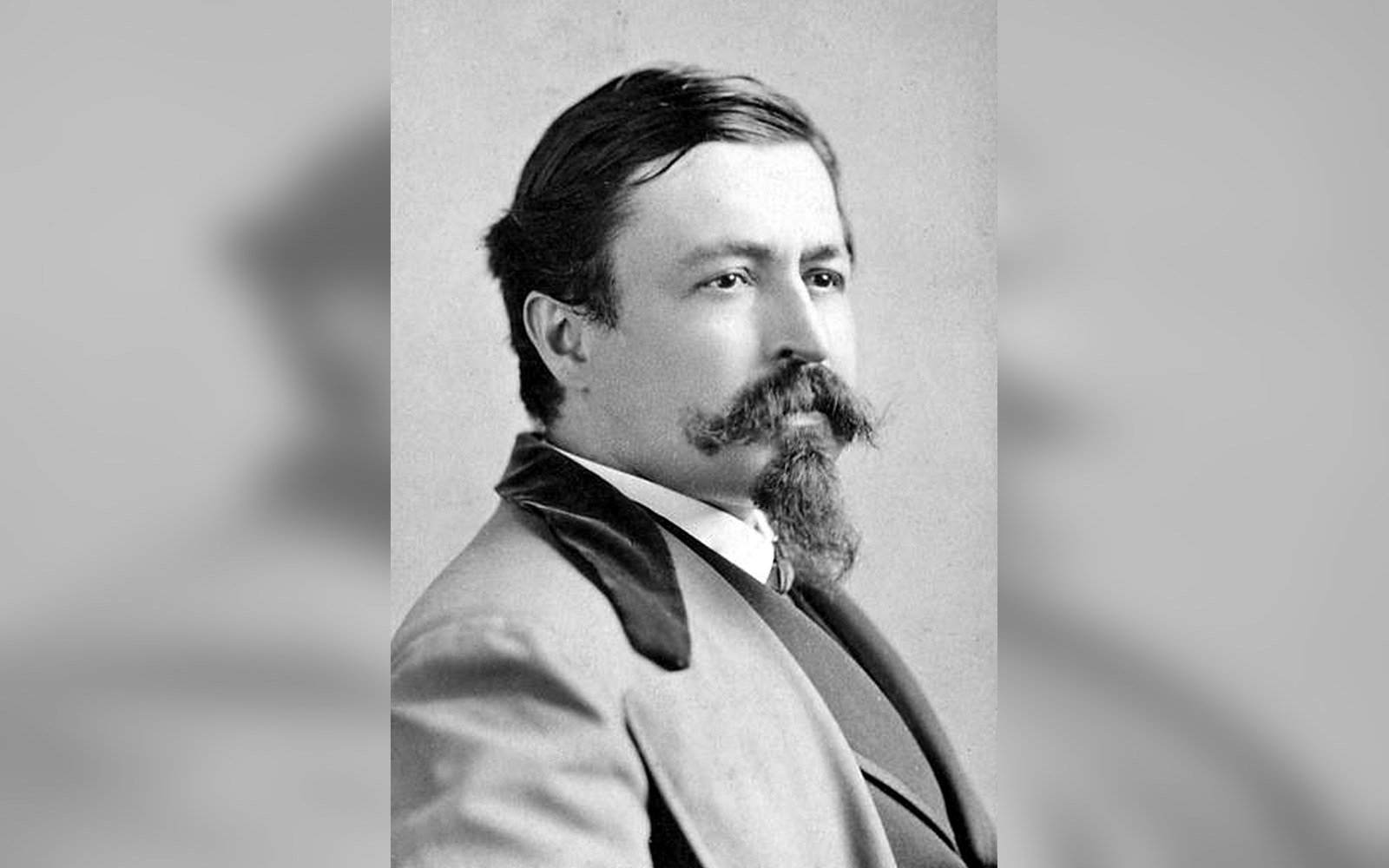
The draughtsman himself, photographed in the years the Ring was still answering him.
Photo: Thomas H Nast · Wikimedia Commons
Thomas Nast was thirty years old when he began the campaign that would define American political cartooning. From 1869 to 1871, working in ink and wood-engraved line for Harper's Weekly ↗, he published a sustained assault on William Magear Tweed and the Tammany Hall political machine that had colonised New York City government so thoroughly that the ring's total theft from the public treasury has been conservatively estimated, by historians drawing on the city's own comptroller records, at between $25 million and $200 million — the range reflecting both the sophistication of the fraud and the destruction of evidence.
Nast was German-born, raised in New York, and had already established his reputation covering the Civil War for Harper's Weekly before he turned his attention to Tammany. He worked in the dominant medium of mid-Victorian illustrated journalism: the wood engraving, in which the design was drawn or transferred onto the end grain of a boxwood block and then cut by a team of specialist engravers who returned the carved block to the press. The process suited Nast's draftsmanship — dense cross-hatching, heavy shadow, a gift for the single symbolic image that could be read across a room. His line had the weight of accusation.
Bound half-yearly volumes are why the weeklies survive at all: loose issues were read to pieces.
Photo: Yaroslav Shuraev / Pexels
The Cartoons Themselves
The campaign's opening volleys appeared in 1869 and 1870, but the decisive sequence ran through 1871. Nast's method was not primarily caricature in the strict sense — the exaggerated portrait of a specific physiognomy — though he rendered Tweed's bulk with evident pleasure. His strength was allegory with teeth: he created situations that accused rather than merely mocked, so that the viewer left the image with a specific charge lodged in mind rather than a general impression of corruption.
The most reproduced cartoon of the series, "Who Stole the People's Money?" (Harper's Weekly, 19 August 1871), arranges the Tweed Ring as a circle of politicians, each pointing to the next, so that the question the caption asks is answered by the composition's infinite loop: all of them did, together, and none will say so. The image owes something to a children's round game, which was precisely the point — the machine's self-protection was childishly simple, and Nast made it look that way.
Chronology
- 1869–1871Nast's sustained Tammany campaign in Harper's Weekly
- 15 January 1870First Nast Democratic donkey, Harper's Weekly ("A Live Jackass Kicking a Dead Lion")
- 26 August 1871"Who Stole the People's Money?" published
- 11 November 1871"The Tammany Tiger Loose" published, immediately before city election
- 23 September 1871"A Group of Vultures Waiting for the Storm to 'Blow Over'" published
- 1871Tweed arrested; Tammany Ring collapses
- 1873Tweed convicted
- 7 November 1874First Nast Republican elephant, Harper's Weekly ("The Third-Term Panic")
- 1876Tweed identified by Spanish authorities from Nast's printed images
- 1878Tweed dies in Ludlow Street Jail
- 1886Nast leaves Harper's Weekly
- 1902Nast dies in Guayaquil, Ecuador
A second major image, "The Tammany Tiger Loose" (Harper's Weekly, 11 November 1871), ran immediately before the city election of that year. Nast depicted a Roman arena: the tiger — Tammany's own symbol — tearing apart a figure representing the Republic while Tweed and his allies watched from the imperial box. The Tiger was not Nast's invention; Tammany had adopted it informally years earlier. Nast's move was to take the machine's own iconography and turn it into an indictment, so that every reader who had seen Tammany's tiger as a badge of civic power now saw it as a predator. The election that followed the cartoon's publication produced significant Democratic losses in New York City.
A third cartoon, "A Group of Vultures Waiting for the Storm to 'Blow Over'" (Harper's Weekly, 23 September 1871), shows Tweed and his confederates perched over the city as carrion birds. The caption's quotation marks around "Blow Over" are reporting: Tweed had publicly expressed the hope that the storm of criticism would pass. Nast refused to let it.

Framed on a wall a wood engraving is an object. On the page it was one week’s argument.
Photo: Beyzaa Yurtkuran / Pexels
What Tweed Actually Said
The documented political effect of this campaign is unusually well-attested, because Tweed's own responses were recorded. When Tammany allies approached Harper's in 1871 and offered what is reported in newspaper accounts of the period as a sum in the range of half a million dollars to stop publication, the offer was declined. More directly, Tweed was recorded asking an intermediary — in a line preserved in multiple contemporary newspaper accounts — words to the effect that he did not care what the papers wrote, since his constituents could not read, but they could see the damned pictures. The precision of the phrasing varies across sources; the substance is consistent. A political boss who survived by controlling a multi-ethnic immigrant electorate was articulating exactly what Nast understood about the medium: the image bypasses literacy.
The Tammany Ring collapsed under the combined weight of the cartoons and the investigative reporting published in the New York Times in the same period. The Times obtained documentary evidence of the frauds through a bookkeeper, and the newspaper and the cartoonist attacked together on adjacent fronts. Tweed was arrested in 1871, convicted in 1873, and died in the Ludlow Street Jail in 1878. Nast's contribution to the prosecution was acknowledged explicitly when Tweed, having escaped to Spain in 1875, was identified by Spanish authorities who recognised him from Nast's printed images — one of the few recorded cases in which a fugitive was captured by a caricature.
The Elephant and the Donkey
The campaign against Tweed was Nast's most consequential single act, but his larger legacy to American political iconography rests on two animal symbols that he fixed as permanent currency. The Democratic donkey appeared in Harper's Weekly on 15 January 1870, in a cartoon titled "A Live Jackass Kicking a Dead Lion" — the dead lion represented the recently deceased Secretary of War Edwin Stanton, and the donkey the Democratic press. The donkey as a symbol of Democratic stubbornness had appeared earlier in American political imagery, but Nast's repetition of the figure across subsequent cartoons was what embedded it.
The Republican elephant made its debut in a cartoon published in Harper's Weekly on 7 November 1874, titled "The Third-Term Panic", in which various animals flee a trap, one of them labelled "The Republican Vote" and drawn as an elephant. Nast reprinted and reworked both animals across the following decade until they were effectively standardised. Every editorial cartoonist who has since drawn a donkey or an elephant in an American political context has been working within the vocabulary Nast handed the form — a remarkable case of one draughtsman's private symbol becoming an entire nation's shared shorthand, documented in the Billy Ireland Cartoon Library and Museum holdings and reproduced in countless American newspaper archives.
After Tammany
Nast's influence on Harper's Weekly outlasted Tweed, but his relationship with the magazine eventually soured, and he left in 1886. His later career, including a brief period as editor of his own journal, did not replicate the combination of institutional support and political urgency that had produced the Tammany work. He died in 1902, in Guayaquil, Ecuador, where he had taken a consular post. The Billy Ireland Cartoon Library and Museum at Ohio State University holds a significant collection of Nast originals, and the Library of Congress Prints and Photographs Division ↗ holds additional period impressions and related material.
What the Tammany campaign demonstrated, and what subsequent editors and cartoonists continued to argue from it, was that a sustained visual attack — not a single image but a sequence, returning to the same faces and the same symbolic vocabulary week after week until the audience could finish the argument without the caption — could do political damage that prose reporting could not do alone. Tweed's remark about the pictures is the most efficient statement of this principle ever made, and it was made, characteristically, by the subject of the campaign rather than its author.