Printing · Plate 02
Senefelder's Stone and What Daumier Did With It
A Bavarian Invention and the Line It Set Free
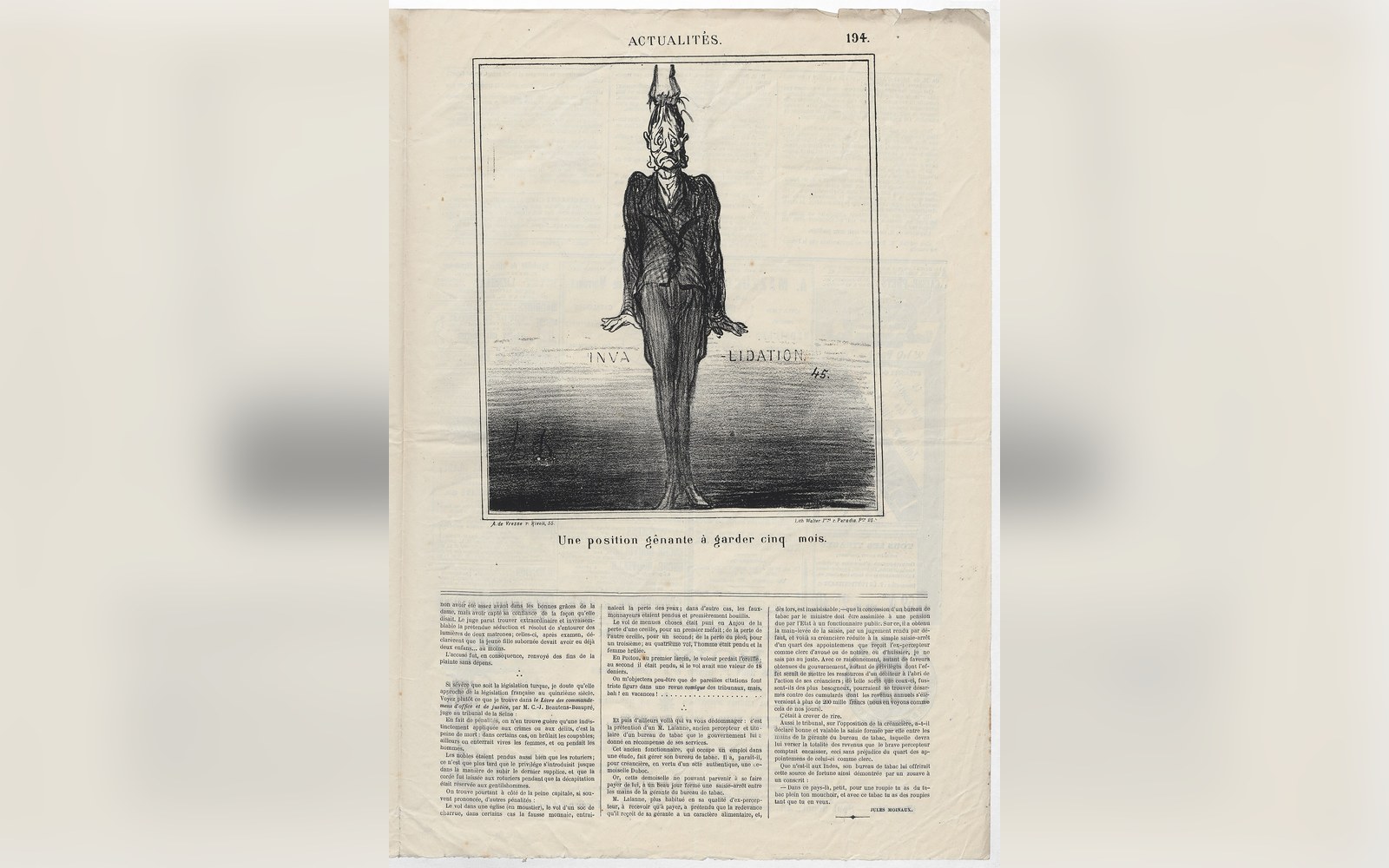
Le Charivari, printed from stone: the grain of the limestone is visible in the greys.
Photo: Le Charivari, trente-huitième année, lundi 6 septembre 1869, 2018.0.2409(3) · Wikimedia Commons
Alois Senefelder was trying to solve a publishing problem: how to print his plays cheaply. Working in Munich around 1796, the playwright and printer discovered that a greasy mark on a flat Bavarian limestone surface, dampened with water, would accept oil-based ink while the bare wet stone repelled it — a process he called lithography ↗, from the Greek for stone-writing. The chemical logic was simple: grease and water do not mix. The artistic consequences took decades to unfold.
The critical difference between lithography and the intaglio methods it steadily displaced was the absence of resistance. An etching needle cuts through wax against the drag of a metal plate; a burin on copper demands controlled force through the whole stroke. A lithographic crayon on limestone moves like chalk on a pavement — freely, at any speed, with immediate tonal variation as pressure shifts. The drawn mark on stone is, more than almost any other printmaking technique, the mark the hand actually made.
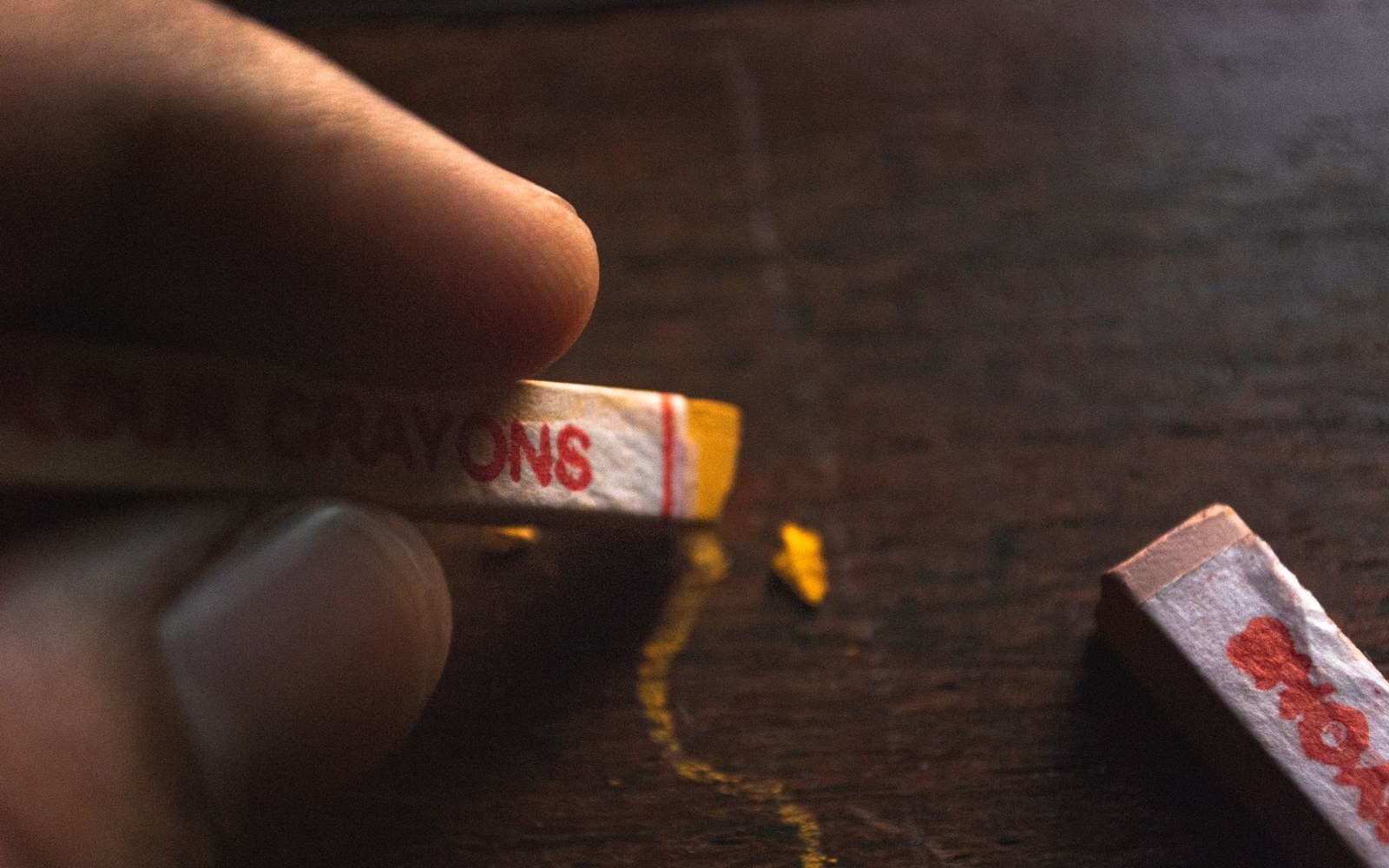
Grease crayon on limestone takes the pressure of the hand. It is why a lithograph looks drawn and an etching looks cut.
Photo: Akshar Dave🌻 / Pexels
French publishers grasped this quickly. By the 1820s, Paris had a flourishing trade in lithographed caricatures ↗, and when Charles Philipon launched La Caricature in 1830 and then Le Charivari in 1832, he gave his principal contributor — Honoré Daumier — a medium precisely suited to what Daumier needed to do. Where Gillray's etched lines carry the accumulated decisions of acid, wax, and needle, Daumier's figures seem seized whole from observation: loose contour, soft shadow built from crayon grain, forms that lean and bulk with a draughtsman's confidence rather than a printmaker's calculation.
The results are visible in any decent run of Le Charivari lithographs, and in collections including the Bibliothèque nationale de France ↗, which holds a substantial body of nineteenth-century French satirical lithographs in its Gallica portal. Daumier produced more than four thousand published lithographs over roughly four decades, a volume that would have been logistically impossible in copper etching — a stone could be drawn, printed, and re-grained for the next image without the laborious plate preparation that etching demanded.
Chronology
- 1796Senefelder discovers the lithographic principle in Munich
- 1818Senefelder publishes his technical account of the process in a German edition (French and English editions followed in 1819)
- 1830Charles Philipon launches La Caricature in Paris, using lithography throughout
- 1832Le Charivari founded; Daumier begins his principal run of political lithographs
- c. 1880sZinc and aluminium plates begin displacing Solnhofen limestone in commercial shops
The Stone Itself
What survives in European museum collections is not, for the most part, the original limestone stones — but the printed impressions pulled from them. Limestone was expensive, heavy, and reusable; once a print run was finished, workshops typically re-grained the surface and began again. A few institutions do hold stones with images intact: the Victoria and Albert Museum preserves lithographic stones in its prints and printmaking collection, and German cultural institutions in the Munich area, where Senefelder's workshop operated, maintain specimens of the Solnhofen limestone he identified as optimal. Solnhofen stone — exceptionally fine-grained, quarried in Bavaria — remained the preferred material for fine lithographic work through the nineteenth century and well into the twentieth.
Britain's adoption of the medium for satirical purposes lagged slightly behind France but was well established by the 1820s, when publishers including Charles Hullmandel brought technical refinement to the London trade. George Cruikshank worked in both etching and lithography, and the contrast between his output in each medium reflects exactly what practitioners of the period recognized: etching for tight cross-hatched precision, lithography for spontaneous wash effects and looser character sketches. The two techniques are not interchangeable; they produce genuinely different pictures, and the differences are legible to any attentive eye.
Senefelder patented and promoted his invention across Europe himself, publishing a comprehensive technical account of his process in 1818. That the method moved from a Bavarian workshop to the front pages of the French satirical press within a generation — and that Daumier then pressed it to its expressive limit — is one of the cleaner causal chains in the history of political printmaking: a playwright's experiment, an entrepreneur's patent, and a cartoonist's wrist.