Draughtsmen · Plate 03
Six Months in Sainte-Pélagie for Drawing the King as Gargantua
The lithograph that made the charge easy to write
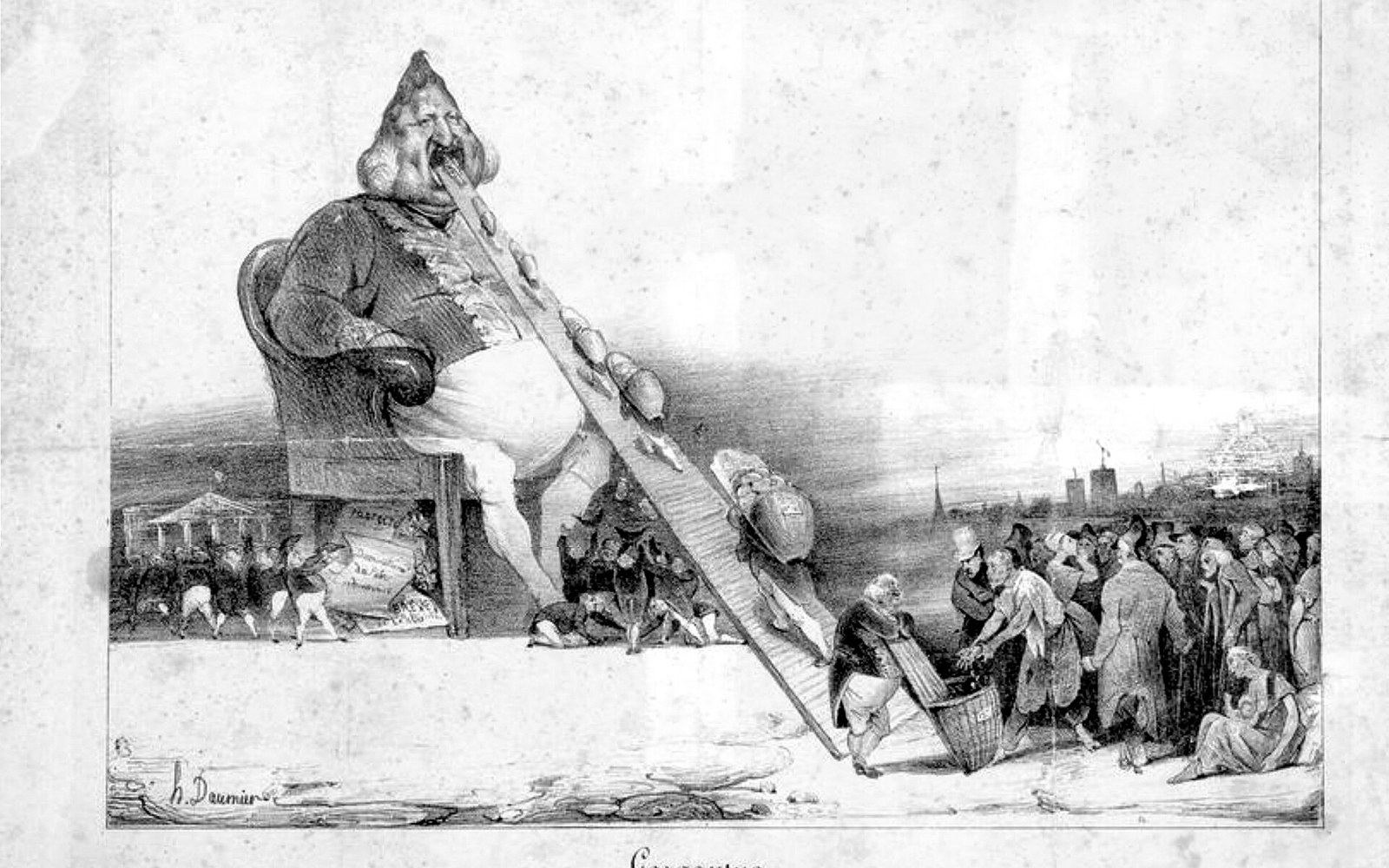
The lithograph that carried a six-month sentence with it.
Photo: Honoré Daumier - Gargantua · Wikimedia Commons
In December 1831, La Caricature — the Parisian weekly founded by Charles Philipon a year earlier as an explicitly oppositional sheet — published a lithograph by a twenty-three-year-old draughtsman named Honoré Daumier. The image was titled Gargantua. It showed Louis-Philippe, King of the French, seated on a commode-throne and tilted forward like a funnel, swallowing a ramp of tax revenue shovelled into his mouth by small figures below while the products of digestion fell, at the other end, into the waiting hands of peers and officials. The reference was to Rabelais, the satirical register unmistakable, the target named by the figure's pear-shaped head — a shape Philipon had already argued in court was not a caricature of the king but merely a fruit. The argument had not saved him; it would not save Daumier.
The lithographic process gave Gargantua its particular force. Daumier drew directly on the limestone, and lithography's planographic freedom — no acid-bitten lines, no engraver's burin to constrain the wrist — meant the figures could be broad, fleshy, and grotesque in a way copperplate could not easily accommodate. The stone carried perhaps a thousand impressions before the image degraded, enough for the magazine's circulation, enough to circulate further by hand. The authorities did not have to wait for the print to spread. The stone was seized, Daumier was arrested, and the charge was insult to the king and the government — offences under the press legislation that had been tightening since 1830.
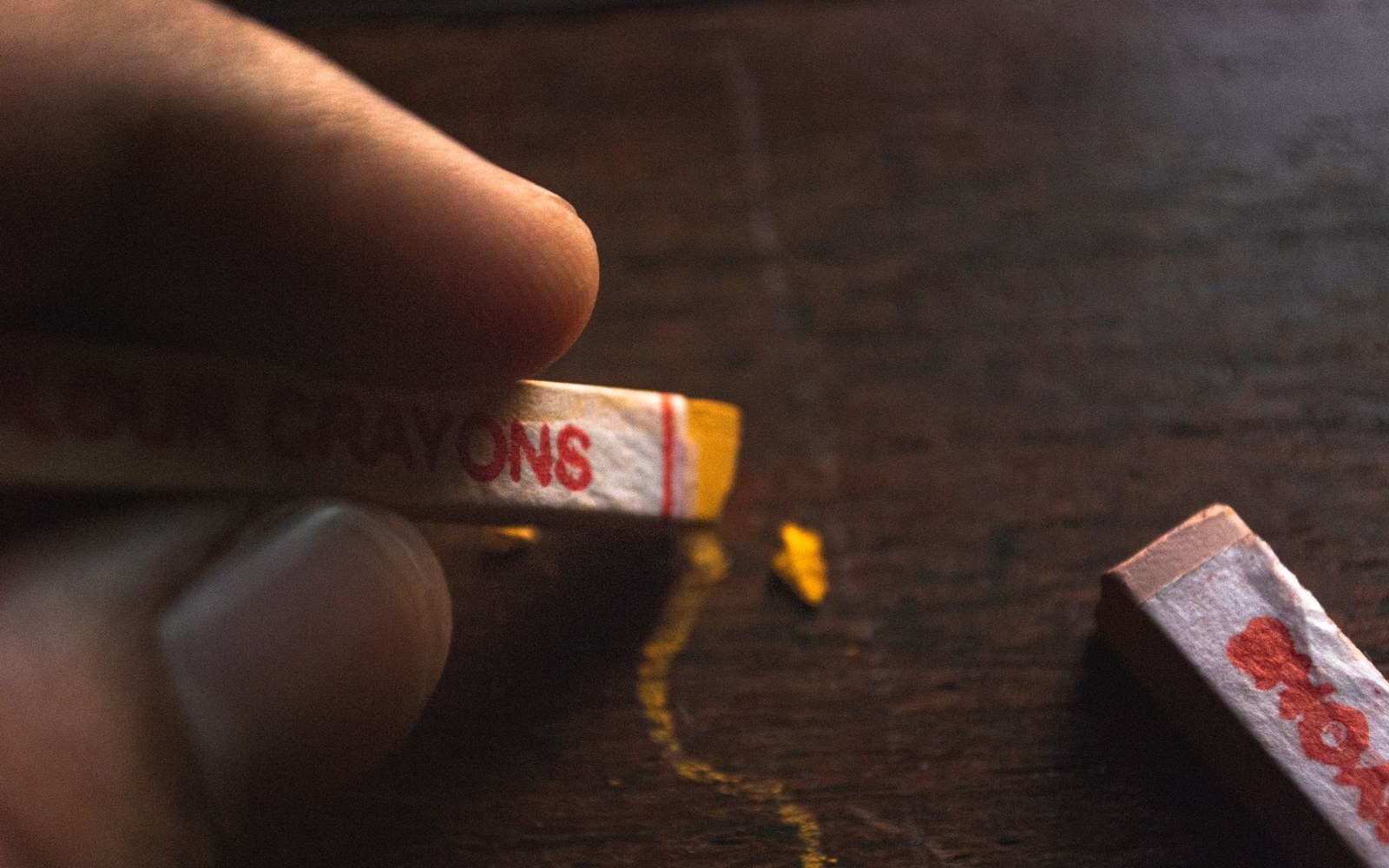
Grease crayon on limestone takes the pressure of the hand. It is why a lithograph looks drawn and an etching looks cut.
Photo: Akshar Dave🌻 / Pexels
The trial, the sentence, and the cell in the Latin Quarter
The July Monarchy that Louis-Philippe headed from 1830 had arrived trailing liberal promises. It did not keep them long where the press was concerned. A series of prosecutions in 1831 and 1832 moved against La Caricature, against Philipon personally, and now against his young contributor. Daumier's trial in 1832 resulted in a sentence of six months' imprisonment and a fine. The prison assigned was Sainte-Pélagie ↗, a former convent in the fifth arrondissement that had served as a place of detention since the Revolution and had become, by the July Monarchy years, a customary address for journalists, publishers, and political prisoners of the left. The irony was noted at the time: confinement in Sainte-Pélagie carried a kind of professional credential among the republican press.
Daumier began his sentence in August 1832. His conditions were not those of a common cell — political prisoners of a certain class were housed in a section of the jail with enough liberty to receive visitors and, in some accounts, to continue working — but he was inside while the city debated his lithograph. Philipon continued publishing La Caricature throughout. The magazine had already established the practice of printing its legal proceedings as editorial content: charges, verdicts, and fines were set in type and offered to readers as proof of the government's hostility to a free press, transforming every prosecution into a subscription argument. During the months of Daumier's imprisonment, La Caricature ran work by other contributors, sustained its attacks on the monarchy, and kept Daumier's name in circulation. He had gone in as a promising lithographer and came out as a figure of some notoriety.
Chronology
- 1830Charles Philipon founds La Caricature; Louis-Philippe becomes King of the French
- December 1831Gargantua published in La Caricature; stone seized shortly after
- 1832Daumier tried, sentenced to six months and a fine; imprisoned at Sainte-Pélagie from August
- 1835September Laws enacted; La Caricature ceases publication; caricature subject to prior authorisation
- 1899Sainte-Pélagie prison demolished
The September Laws and the closing of the space
What the Gargantua prosecution foreshadowed was codified in 1835. The September Laws — passed after the Fieschi assassination attempt on Louis-Philippe in July of that year — imposed the most sweeping press restrictions France had seen since the Restoration. They required caution money from publishers, extended the definition of offences against the king and his family, and specifically prohibited the publication of caricature without prior governmental authorisation. The graphic satirical press, which had flourished between 1830 and 1835 in a way that had no European equivalent — La Caricature, and the daily Le Charivari that Philipon had also founded — was not killed outright by the September Laws, but the space in which Daumier ↗ had been working effectively closed.
La Caricature ceased publication in 1835, the year the laws were enacted. Le Charivari survived by moving toward social satire — the mœurs (manners and customs) of bourgeois Paris rather than the face of the king — and Daumier moved with it, producing the lithographic series that would eventually make his reputation in a different register: lawyers, theatregoers, railway passengers, physiognomies of the legislature. The political caricature did not disappear, but it was displaced. The planche — the stone — carried other arguments for the next decade and more.
A plan chest holds prints flat and unfolded, which is why a sheet pulled in 1805 still lies straight.
Photo: Sydney Sang / Pexels
What the episode fixed in the history of the form
The Gargantua imprisonment sits at a specific juncture in the history of press law and political image-making. It was not the first prosecution of a caricaturist — Philipon had preceded Daumier into the dock — but it was, by the standards of subsequent history, the most consequential single case in French graphic satire: a young draughtsman, a single stone, six months inside, and a law four years later that reshaped what the press could draw. The episode is documented in the holdings of the Bibliothèque nationale de France ↗, which holds original impressions of Gargantua and issues of La Caricature in its Gallica digital archive, where the lithograph's scale and the surrounding text of the magazine can be examined together.
For the history of political cartooning as a form, the case establishes something that would recur: prosecution does not suppress an image but amplifies it. Daumier's name attached to Gargantua because of the trial. The government's decision to prosecute fixed the lithograph in the record, gave it a legal identity, and ensured that histories of the press and of the July Monarchy would carry it forward. Sainte-Pélagie is long gone — the prison was demolished in 1899 — but the stone's impression, the charge sheet's language, and the sentence's duration are the coordinates by which one image in a weekly satirical magazine became a reference point in the law of political expression.