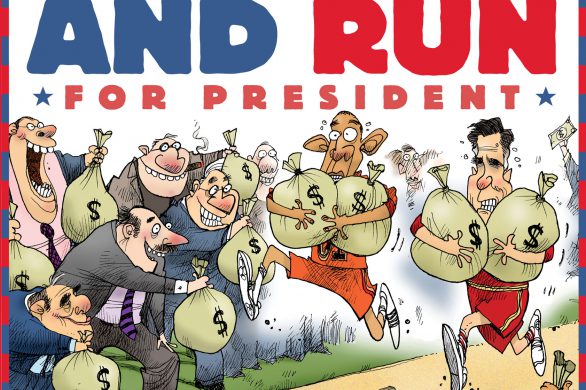

Having devoted a cartoon to Christopher Hitchen's rejection of his lefty buddies, I found this counter-rejection from a Hitchens protegé funny, sad and puzzling. Dennis Perrin provides personal insight into the transformation of Hitchens from an independent-minded socialist to a flakk for neocon causes, from an opponent of Gulf War I to a proponent of Gulf War II. The lynchpin is not September 11th, but Bill Clinton:
Though hardly soft on Saddam, he still understood the imperial pecking order, the context in which vast power is wielded, the cynicism of it, the horror. He eviscerated the Bush gang with substance and style, and ripped through its apologists. Hitch was hitting all cylinders when he came across Bill Clinton in New Hampshire. Christopher had met his match: an Arkansas political pro with blood money behind him, a hustler and charmer impervious to journalistic assault, a con man so skilled at lying that even those wise to his game were impressed with his performance. Hitch, of course, went straight for Clinton's throat. But he never could get his hands on Clinton, and this fed a frustration that became an obsession.Pundit wonkery courtesy of Atrios.By this time, Hitch and I saw each other intermittently, spoke by phone occasionally. I'd learned all I could from him and moved on. But I continued to read him and catch his TV appearances when possible. I was sympathetic to his anti-Clintonism, but there was something different about him. Hitch seemed harsher, meaner, sloppier in his attacks. His hatred of Bill and Hillary led him to link arms with the likes of Ann Coulter and the insane David Horowitz, a man who shouts "TREASON!" every 90 seconds. What the fuck? I thought. Why was Christopher going this twisted route? Whenever I asked him about it, he'd be polite but vague. He maintained that he wasn't bound by ideology, so appearing with Coulter at a Free Republic gathering meant little compared to the larger fight against Clinton. "I'll take what I can get," he said.
I dunno, I think he and Dennis Miller have been drinking from the same weird poisoned chalice...
Posted by: Elayne Riggs at July 9, 2003 02:18 PMGod, I forgot about Dennis. Here's my guess. Both Miller and Hitchens have these pretentious contrarian personas. They have surrounded themselves with liberal intellectuals, they read liberal humanities journals and policy magazines. Over time they mistake the conventional wisdom among a lefty elite for the CW of the political elite—mistaking, if you will, the college campus for Capitol Hill—against which, post-9/11, they mount diatribes of ever-worsening invective and intellectual sloppiness, thinking somehow they are popping the big CW balloon in the cause of freedom and intellectual rigeur. But in reality, they are just being cranky assholes.
That's my theory.
Posted by: Kevin Moore at July 9, 2003 02:35 PMI read Perrin's column, then realized I'd just wasted 15 minutes of my 55-year-old life thinking about Hitchens. It's not a mistake I'll make again. (I'll make a different mistake, waste time on something else...)
Posted by: Steve Bates at July 9, 2003 06:56 PMHey, you can be a cranky, Clinton-hating asshole and still not like Shrub !!
Now, when are you gonna' buy we a beer an' a shot, Kev ?
Posted by: Amy S. at July 9, 2003 09:27 PMYou are right in pointing out that there is a paralell between hitchens. But your concusions err.
9/11 has watered the seeds for a great schism within the left. It is between, on the one hand, those who advocate self-criticism as a responsibility and who are willing to look beyond a leftist model for new ideas, and on the other hand, those who are unable to amend or renounce a model of the world that has served them for a lifetime.
By concluding that Hitchens and Miller sold out; you do more than disagree with them; you show what your ideology will drive you to do (excumunicating former friends the way the fellow traavellers did to orwell camus and many others).
The differentiating question asks whether or not ones world view is dynamic. Is each encounter with historical phenomena going to result in lucid, honest and vigorous deliberation?
Or will an event’s causal status be tampered with (even unknowingly) so that every phenomenon fits into a pre-existing paradigm?
Among the first group dwell the leagacies of Camus and Orwell and living intellectuals like Hitchens and Miller. The second group, which for the time being is more powerful on campus, is led by the likes of Chomsky and Tariq Ali and is haunted by Sartre and other experts in bad faith.
The comparison of Hitchens to Orwell and to Camus should be obvious.
Orwell and Camus have been consistent foes of imperialism: They both wrote and fought to end colonial rule. They were among the first to support the struggle (in Orwell’s case to bear arms) against fascism in Spain. While fighting in Catalonia, Orwell saw through and resisted the ideological siren’s song that seduced so many intellectuals into totalitarian apologetics, and Camus refused to join his contemporaries when they chose to dismiss the gulag in the name of freedom.
Both were pressured and eventually excommunicated by the left. The reason most consistently given is that they had betrayed the cause.
Nonsense: Their word view was dynamic by design. New situations can cause a dynamic paradigm to amend itself, even renounce itself. In this case, they realized that they could be against Nazism without supporting Stalinism, without committing, in effect, the fallacy of false dilemma.
In some ways one can understand the reluctance that some intellectuals have when it comes to renouncing a paradigm. It must be difficult to come to grips with the fact that they have spent much of their lives and energies believing in a god that has so miserably failed.
Fanatical adhesion to any great system-building philosophy, whether in Hegel or Marx, or even in the project set forth by Russell and Whitehead is essentially dogmatic. Faith in such systems, despite an utter lack of evidence and often against a flood of counterexamples, seems to be of the type that would be prescribed by Augustine himself. In fact such conviction often irrationally intensifies itself as a reaction to evidence to the contrary, much like the faith of the true believer does when he his tested.
The success that Marxism has enjoyed rivals in some ways that of the Newtonian paradigm. But whereas the Newtonian paradigm owes its durability to its predictive, scientific character, Marxism’s success is entirely due to its baseless prophetic optimism, most of which has been proven to be false. Spiritual certainty is not easily dislodged, and faith emerges from the psychological need for a black and white universe (It is the same need that drives people to Jehovah). In this sense Marxism performs the function of an “oxymoronic secular religion” that mirrors and magnifies all the evils identified by secular critiques of religion itself.
To be free of such faith and certainty means accepting total responsibility; it can be accompanied with a sense of dread. On the other hand it means that we individuals are no longer reified, no longer cogs in the deterministic machinery of the world (whether in History or in Our Father’s Heavenly Plan). And this is a good thing, even if it does involve an unknown yet to be shaped landscape.
The best contemporary example of a public intellectual with a dynamic world-view is Christopher Hitchens.
Here is someone who is not a contrarian just for the sake of contrarianism. He allies himself with entities that he simultaneously criticizes…and distances himself from former allies who have proven that their world view is not dynamic, who have revealed themselves as the offspring of those who, having failed to save the world by bringing us socialism (that most modernist idea), are turning anti-modernist, anti-globalist and want now to save the world by going back to the stone age.
Clearly much of the recent criticism from the leaders venomous left comes from people who feel their dominion shrinking, and who have no choice but to resort to this sort of vituperative pompierisme. What is noticed more than anything else is the overwhelming monolithic and predictable character of their position; everyone strikes the same subversive pose. Nowhere in this group can be found the philosophical calm, the objectivity and the intellectual self-monitoring that one would expect from a well-educated elite. And the sycophantic followers are worse!
Most of the ideological lava that spews from these volcano-savants is a disorderly, random, accumulation of platitudes and nonsense shooting in all directions.
Sept 11 is one of many thought experiments that can reveal just how much one can cling to an ideological posture.
Often what absconds from underneath their breath and between their words is a notion that in some way glorifies the terrorists’ will to martyrdom as a much more noble (albeit naïve) pursuit than the greedy will to power (The Demiurge of globalization). There is always a reluctance to acknowledge that the terrorists were Muslim fanatics and that globalization was probably the least of their concerns (although the terrorists all would have welcomed, to be sure, global Islam).
The horrific event is thus banalized to fit the thesis, which is that every act against the US (the west in general) is a reaction against Evil. In this view the very existence of the west is original sin.
A reaction to original sin is thus a victory not only political, not only economic but
Hurray!!
…a victory against freedom itself!
Camus and Orwell were geniuses and Hitchens isn't.
Posted by: J. Pinkham at February 18, 2004 09:53 PMHitch is a keen mind and a fine writer. But his drama queen defection from "the Left" over the war in Iraq—which, um, he seems to have been wrong about (oops)—coupled with his mostly unreasoning diatribes against anyone who entertained the idea that US foreign policy has made a roost for some chickens have made of him a silly character indeed.
And, no, he's no Orwell. Or Camus. Let's hope he doesn't turn into Ann Coulter.
Posted by: Kevin Moore at February 19, 2004 12:39 AM